Back to the previous menu
at this time, donations are not tax deductible
A local community member is managing funds until an EIN can be obtained for non-profit status, which is delayed due to the federal shutdown.
All funds will be used responsibly for signage, shirts, legal fees, and other awareness efforts related to this project.
Thank you!
Back to previous menu
Do you have skills you can volunteer? We need help in tons of different ways: writers, researchers, canvassers, etc
we need volunteers!
send us an email
submit
Back to previous menu
Thank you! We will reach out to you shortly
Back to previous menu
Why stop the data center
- We demand that the City of Hermantown conduct an Environmental Impact Statement to better examine this massive project.
- We are opposed to the use of NDAs to obscure public awareness of what city officials are discussing and deciding.
- We are concerned about the overall impact that this data center will have on the environment, including light, sound, water, and air pollution.
- We are concerned about increased taxes, utility rates, and other “kitchen table” expenses this proposed data center may have on citizens.
- We are concerned about the added wear and tear of our local resources and the existing infrastructure of the region.
- We want to preserve this historic rural, agricultural corner of Hermantown.
- We want broader citizen input in the process for deciding the merits of this data center.
- We are concerned this will be put in a residental area
- We encourage the community to contact their elected officials with their concerns and ideas about this data center and request accurate information and transparency.
We are a nonpartisan, collaborative group uniting residents from Hermantown, Solway, and Midway townships as well as the surrounding communities. We are gathering together to stop further progress of the proposed Hermantown Data Center until transparent information is provided regarding energy and water consumption, environmental impacts and effects on residents and the larger community. We insist that a transparent and robust environmental review be completed.
Who We Are
Resident Intervention Halts Hermantown Power Line Vote Over Year-Long Environmental Non-Compliance
HERMANTOWN, MN — A controversial transmission line resolution related to the proposed Google hyperscale data center was abruptly tabled by the Hermantown City Council on October 8, 2026, after local residents exposed that City staff appear to have concealed a year-long environmental ordinance violation from elected officials.
During the meeting, the City Council was prepared to vote on Resolution 2026-125, which would approve a 1.6-mile parallel 230-kV transmission line project by Minnesota Power to connect its local substation to the proposed data center. During the public comment period, however, several alert citizens revealed that the City of Hermantown’s shoreland ordinance has been out of compliance with Minnesota Department of Natural Resources (DNR) requirements since October 2025, and that an October 1, 2026 deadline to bring it into compliance had passed.
Residents educated the City Council on the non-compliance issue and quoted additional concerns raised by the DNR, including that placement of the transmission line be relocated due to waterways and other environmental concerns.
Members of the Stop Hermantown Data Center (SHDC) released the following timeline and breakdown of the events:
The Shoreland Ordinance Non-Compliance Oversight
· Withheld Evidence: Documents obtained via the DNR show that Hermantown Community Development Director Eric Johnson was explicitly notified of the shoreland ordinance violation over a year ago, in October 2025.
· Omission in Testimony and Lack of Responsibility: During official project presentations to the council, however, neither Minnesota Power representatives nor Director Eric Johnson disclosed the regulatory non-compliance. Instead of taking responsibility and owning the omission and non-compliance issue(s), Director Eric Johnson placed blame on the DNR.
· Late-Stage Intervention: The City Council appeared to be unaware of the City’s non-compliance until residents formally introduced the DNR documents during the public comment period. Following the revelation, the City Council rightfully voted to table the transmission line resolution until compliance is met.
A Pattern of Administrative Misdirection
SHDC emphasizes that this incident is not an isolated oversight, but part of a documented pattern by City staff to withhold critical information from elected leaders to force the data center project forward including, but not limited to the following examples:
1. AUAR Disregard: Staff previously ignored and/or omitted substantive DNR feedback during the updated Alternative Urban Areawide Review (AUAR) process, until residents raised concerns during public comments at City Council meetings. At the October 5, 2026, City Council Meeting, the City claimed that the DNR had endorsed the AUAR, when, in fact, the DNR explicitly cited several unresolved issues of concern related to project impacts and necessary mitigations.
2. Comprehensive Plan Manipulation: City staff abruptly halted engagement with the 2045 Comprehensive Plan Steering Committee, altered the plan behind closed doors, including modifications to the City’s vision statement, to further the data center project and presented it for City Council approval while keeping the Steering Committee members’ names attached to it in an effort to legitimize and validate the changes.
3. Data Center Denial: City Staff secretly worked with developers and others to further the data center project for over one year while directly denying knowledge to concerned residents. Two City staff members, namely, John Mulder and Joe Wicklund, signed Non-Disclosure Agreements (NDAs) in May 2024, and the Mayor was informed by City staff in September 2024 of the data center project, thereafter, working for nearly one year to tailor changes in zoning, land use definitions, and the comprehensive plan to fit the needs of the project, while denying existence of the project to directly affected residents.
4. Hampering Public Process: The City has hampered opportunities for public input on at least four occasions by providing extremely limited notice and scheduling meetings or events during typical working hours including, but not limited to: the 2045 Comprehensive Plan open house on March 4, 2025, was communicated just one day prior via a social media post; the Project open house on June 24, 2026, was noticed 8 days prior; the 230kV Transmission line public scoping meeting was held 10:30 am to noon on Monday August 10, 2026; and, the second project open house on August 19, 2026, was advertised just three days prior in the Duluth News Tribune.
SHDC notes that, “Approving Resolution 2026-125 could have exposed the City to severe legal risk, signaling a willingness to operate above the law and prioritize corporate profits over people. While we are pleased the City Council tabled the resolution until compliance is met, SHDC remains unyielding in our opposition to the hyperscale data center project.”
We are convinced the City of Hermantown has abdicated its regulatory responsibilities and is operating far beyond its competency on this project. There is clear evidence that City staff are intentionally feeding the City Council inaccurate information and/or withholding critical information in order to advance this project. We give immense credit to the citizens who conducted the research and discovered this important issue, and we will continue fighting for transparency and community protection.
In solidarity,
SHDC
Read more…
For Immediate Release
Thursday, August 13, 2026
Media/Press Contact: stopthehermantowndatacenter@gmail.com
STOP THE HERMANTOWN DATA CENTER
Recorded Ridicule by City Leadership Raises Questions About Public Trust, Prompting a Call for Discipline and Independent Investigation
Residents who step forward to participate in their local government should be able to trust that their voices will be heard, their questions and concerns taken seriously, and their participation treated with respect. Newly publicized recordings of Hermantown City staff meetings challenge that expectation. They have captured senior City personnel mocking residents, making comments involving race and individuals’ names, and discussing actions that spark doubt in the transparency and independence of the City’s decision-making process surrounding the proposed Google hyperscale data center. The ease with which these comments were made and the timing between the recordings implies this is unlikely to be separate, isolated incidences and suggests a culture of this type of behavior.
The recordings go beyond unprofessional comments. They raise concerns about scripting conversations between elected officials and developers in order to manipulate the public, shaping the presentation and public perception of a deeply unpopular project, and discussions about keeping communications outside email to avoid disclosure through public data requests. The recordings raise legitimate questions about whether City administration has remained a neutral administrator of the process or has moved into advocating for and advancing a private development project.
Residents should never have to wonder whether questions asked by their elected representatives were prepared behind the scenes, whether official conversations were intentionally kept outside normal public-record channels, or whether their participation in local government is being treated with contempt rather than consideration.
These concerns cannot credibly be resolved solely by the administration whose conduct is in question. In response, Stop the Hermantown Data Center (SHDC) is calling on the Hermantown City Council to immediately assert its statutory authority and ethical obligation to begin to restore public trust by taking the following actions:
- Disciplinary action, not excluding removal from position, for those involved in these recordings, including but not limited to, City Administrator John Mulder, Assistant City Administrator Joe Wicklund, Economic Development Director Chad Ronchetti, Community Development Director Eric Johnson, Chief of Police Jim Crace, and City Attorney Gunnar Johnson.
- Immediately pause further discretionary City action on the proposed hyperscale data center while the issues raised by the recordings are independently reviewed.
- Commission an independent investigation into the conduct documented in the recordings, including treatment of residents, the integrity and independence of the City’s decision-making process, and any attempts to circumvent requirements of the Minnesota Government Data Practices Act.
- Publicly disclose all non-privileged scripts, prepared questions, talking points and similar materials provided to the Mayor or City Council regarding the proposed hyperscale data center, including who prepared and received them.
- Require the Mayor and City Council members to disclose whether they received or used prepared questions or talking points concerning the project during public meetings or work sessions.
- Conduct an independent review of material City actions involving the proposed hyperscale data center to determine whether any should be reconsidered because the integrity, independence, or legality of the process may have been compromised.
- Acknowledgment and an apology from the City to the residents who were personally disparaged in the recorded meeting.
The recordings speak for themselves. The question now is how City leadership will address what they reveal. It has been a week since the first article was published by the Duluth Monitor and the City of Hermantown has yet to acknowledge it. SHDC has a firm belief of the concept of “tone at the top,” meaning that leadership actions and expectations set the ethical climate, values, and behavioral standards for the entire organization. The proposed hyperscale data center carries significant and lasting implications for Hermantown, Duluth, and the surrounding region. Regardless of one’s position on the project, decisions of this magnitude require a process the public can trust.
Citizens should never become the punchline for participating in their own government. Until these serious questions about transparency, neutrality, and process integrity are independently addressed, SHDC believes further discretionary action on the proposed hyperscale data center must be paused.
Clips from the recordings of the Hermantown city staff meetings are available via The Duluth Monitor’s YouTube page:
Read more…
Video of the data center education and awareness event, featuring comedians Charlie Berens and Mary Mack, is now available to watch online.
Read more…
On July 14th, Stop the Hermantown Data Center sponsored an AI data center education and awareness event hosted by comedian Charlie Berens. Charlie has been reporting on AI data center projects across Wisconsin and Minnesota via his YouTube channel.
Speakers at the event were:
- Mary Mack, comedian and writer.
- Rebecca Gilbertson, scientist, educator and Hermantown resident.
- Prescott Balch, Village of Caledonia Board President and a retired technology executive.
- Lori Huntoon, geologist and educator.
- Amanda Mueller of Great Lakes Neighbors United, a Port Washington resident and retired engineer.
- Alex Morrisseau, an environmental advocate, student, and lifelong water protector.
The presentation from the event is available to download in PDF format:

The presentation by Prescott Balch is available to watch on YouTube:
Additional links:
Read more…
Hello friends, supporters and interested public! Here is a draft letter you can send to the City of Hermantown as comments on the Draft Alternative Urban Areawide Review for the proposed Google Hyperscale Data Center project in Hermantown.
Just start a new email, copy and paste the below text into the email message, customize it as you see fit, and send it before 4 p.m. on July 16 to: AUARComments@hermantownmn.com
⁂
Dear City of Hermantown,
I am writing to express several concerns regarding the Draft Alternative Urban Areawide Review (Draft AUAR) for the proposed Google Hyperscale Data Center project in Hermantown.
As an initial reminder, a public survey conducted by the University of Wisconsin-Superior found that 74% of local people oppose or strongly oppose the data center. The City should act in the interests of this huge majority and cancel this project. Alternatively, the City should at least pause this project and support a statewide moratorium on data centers during which a state-wide environmental review can identify best practices on siting, project design and mitigations before decisions are made with lasting consequences.
If the City proceeds with this project, an Environmental Impact Statement (EIS) is necessary instead of an AUAR. This hyperscale data center is a major industrial project which will create significant adverse effects. The public deserves full disclosure of project details and the opportunity to comment on them, instead of general statements about how several issues could be dealt with after the AUAR is complete.
A key issue that deserves better study and disclosure of project details through a full EIS is more information related to the closed-loop water cooling system that was newly revealed to be part of the project. This system will likely require the use of toxic chemicals to treat the water that will eventually be discharged as industrial wastewater. A full EIS would also require disclosure and specific details regarding backup power use. Huge diesel generators will produce air and noise pollution that will harm people, wildlife, and the environment. These issues, in addition to significant negative impacts to water sources, including nearby trout streams, continuous construction and operations noise, Low Frequency Noise (LFN) and other impacts on residents and the surrounding community have not been fully disclosed.
This project stands to degrade the environment, the value of properties, and the quality of life of the people in the community, especially those living near the data center, but has broader implications as well. This project is driving Hermantown toward a fully urbanized future, no longer maintaining a community which balances urban, suburban, and semi-rural areas.
This is not the future we want for Hermantown’s current or future generations.
Thank you for considering these comments.
Read more…
If you are a Hermantown resident and you treasure your rural lifestyle, PLEASE READ THIS POST, then share it with anyone you know that also treasures their rural lifestyle.
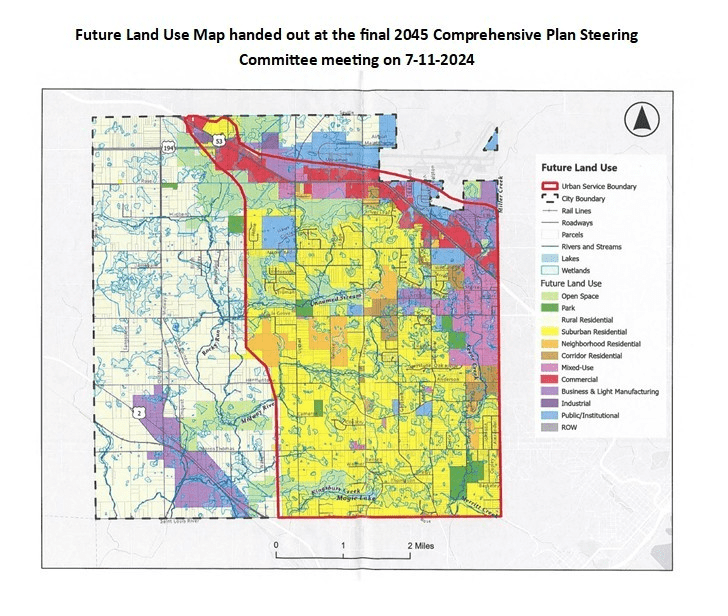
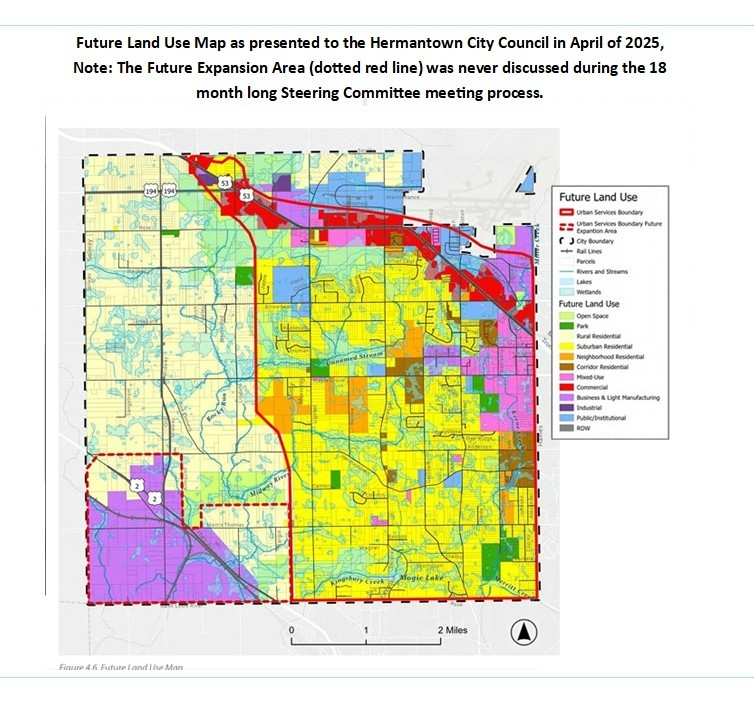
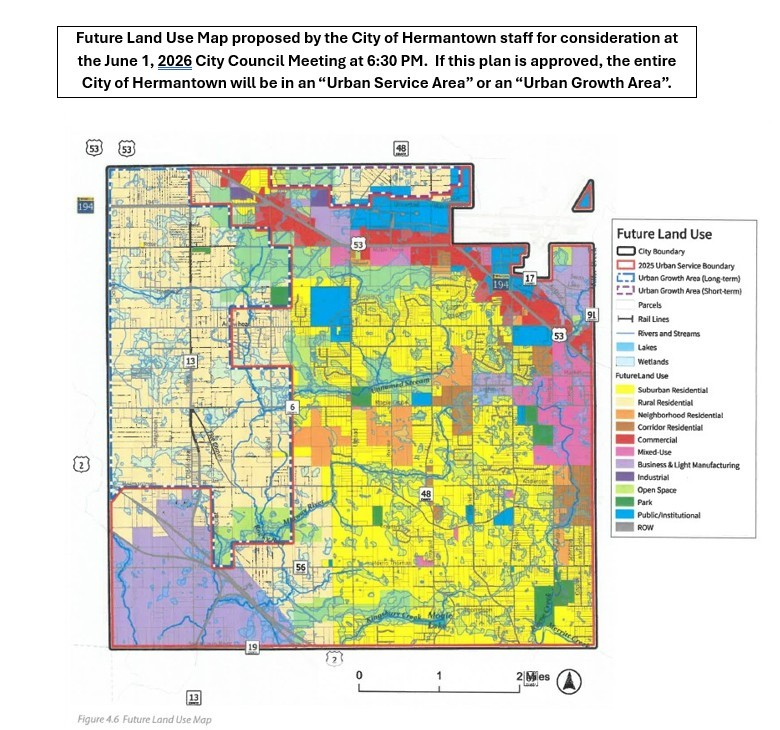
The data center is the catalyst, but the changes that will be decided at the Monday (6/1) City Council meeting at 6:30 PM will change ALL of Hermantown permanently. The City of Hermantown changed the 2045 Comprehensive Plan without the Steering Committee’s involvement in late 2024 and early 2025. The city staff has now been instructed that the sneaky changes they made did not go far enough, so they need to change the plan again. This time they are identifying the entire City of Hermantown as either a “Urban Service Area” or an “Urban Growth Area”. The maps posted here are just the easiest way to describe the most egregious changes. They are actually proposing to change dozens of pages in the 2045 Comprehensive Plan. One example of a drastic change from the current plan to the proposed plan is on page 52:
Current Plan: “4.1.4. Limit the extension of urban services (city sewer and water) to the western portion of the city for residential development while there is sufficient developable land available within the current urban services boundary to accommodate the city’s projected population growth.”
Proposed Plan: “4.1.4. Expand the urban services (city sewer and water) to encompass the entirety of the City, however phase the expansion in order to provide short term and long term growth opportunities.”
The community has not been involved in any of these decisions. As a Steering Committee we met for over 18 months discussing and molding the 2045 Comprehensive Plan. The plan that was ultimately approved in April of 2025 was changed dramatically from our last meeting in July of 2024 and now they want to change it again without any community dialogue.
Please read the agenda packet for the Planning and Zoning meeting that was held on Tuesday (5/19), There is a lot of interesting information in this agenda packet, but if this is the issue that concerns you, save some time and go directly to page 42. The pages that include the most significant changes are: 54, 57, 59, 74, 75 and 82.
Please send messages to the City Councilors. Show up on Monday (6/1) at 6:00 PM, meeting starts at 6:30 PM and talk directly to the city councilors about your concerns. The decisions that are made the June 1, 2026 city council meeting have the potential to permanently change the character of Hermantown. We need everyone’s voice! It’s time to protect the rural character of Hermantown.